Emerging innovations in scent-based navigation are opening new pathways for people with visual impairment to move confidently through unfamiliar environments. Instead of relying solely on audio cues or tactile markers, scent-based systems use strategically placed fragrances to create directional guidance. This new approach seeks to complement existing mobility tools and offer an additional sensory layer that is intuitive, natural, and accessible. As urban infrastructure evolves, scent-driven navigation could become a transformative tool for enhancing independence among visually impaired individuals.
The concept works by associating specific scents with certain directions, landmarks, or pathways. These scents act like olfactory breadcrumbs that guide users toward their intended destinations. For individuals facing visual impairment, the ability to detect and follow these scent tracks provides an empowering alternative to visually dependent systems. As research advances, scent-based navigation may soon become a practical addition to public spaces, schools, transportation centers, and even large indoor facilities.
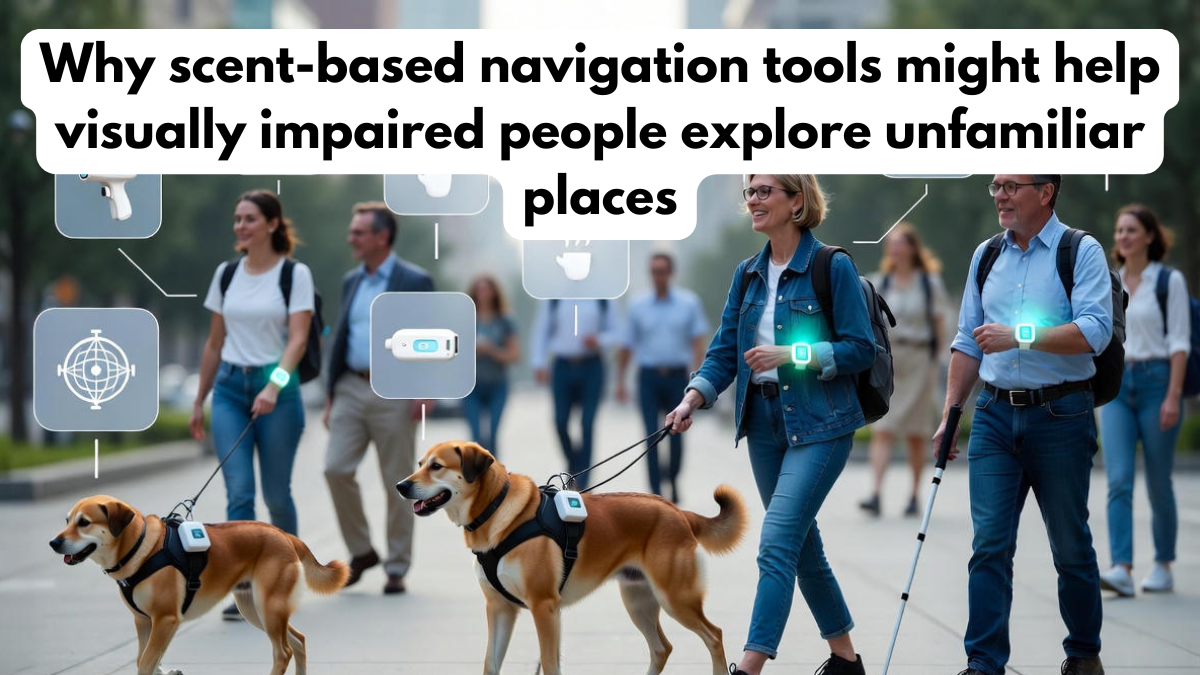
How Scent-Based Navigation Supports Mobility Independence
The value of scent-based navigation lies in how naturally humans respond to smell as a directional sense. Unlike audio signals that may get lost in noise, or tactile pathways that require close physical proximity, scent cues float through the environment, allowing users with visual impairment to follow them without interruption. This approach reduces cognitive load by allowing individuals to rely on familiar smells rather than constantly interpreting new environmental cues.
In unfamiliar locations, people with visual impairment often depend on guide dogs, canes, or digital assistance devices. While effective, these tools may not always offer reliable spatial awareness in complex settings. Scent-based navigation introduces an organic alternative that does not require constant interaction with technology. By integrating different scents into route networks, users can feel more comfortable exploring new areas independently.
Key Benefits of Scent-Based Navigation
The potential advantages of scent-based navigation extend far beyond simple directional guidance. Strategically used scents can offer meaningful clues about turns, hazards, or significant landmarks. These improvements contribute to a more supportive environment for individuals experiencing visual impairment.
Notable benefits include:
- Non-intrusive directional assistance
- Improved confidence in unfamiliar areas
- Reduced reliance on audio cues that may be drowned out
- Enhanced spatial awareness
- Better mobility planning for people with visual impairment
- Compatibility with existing navigation tools
Table: Comparing Various Navigation Methods for People with Visual Impairment
| Navigation Method | Benefits | Limitations |
|---|---|---|
| Scent-Based Navigation | No noise interference; intuitive for users with visual impairment | Requires proper placement and scent maintenance |
| Audio Navigation | Highly accessible; easy to integrate with apps | Background noise can disrupt clarity |
| Tactile Pathways | Helpful for immediate guidance | Requires physical contact; limited in complex environments |
| Guide Dogs | Personalized support | Training and maintenance required |
This comparison highlights why scent-based navigation is gaining traction as a complementary mobility innovation, especially for users with visual impairment seeking more intuitive guidance options.
Implementation in Public and Private Spaces
Incorporating scent-based navigation in real-world environments involves thoughtfully placed fragrance emitters or scent markers. These markers release distinct scents at key decision points—such as intersections, doorways, elevators, or pathways—to help users identify their direction. For individuals with visual impairment, odor patterns provide instantly recognizable cues without demanding complex technological interaction.
Future smart cities may combine scent-based navigation with digital mapping systems, enabling personalization for users. For instance, a particular route could emit scents in specific sequences, allowing users to build familiarity over time. Schools, airports, hospitals, and shopping centers are ideal starting points for implementing such systems, offering improved accessibility for visitors with visual impairment.
Conclusion
As advancements in accessibility accelerate, scent-based navigation shows immense potential to reshape how individuals with visual impairment interact with their surroundings. By offering a natural, intuitive, and inclusive guidance system, this technology supports greater independence and mobility confidence. As cities and institutions explore more innovative accessibility solutions, scent-based navigation may emerge as a powerful tool in creating safer and more supportive public environments.
FAQs
How does scent-based navigation work?
It uses strategically placed scents along routes to guide individuals by associating specific smells with directions or locations.
Why is scent-based navigation helpful for people with visual impairment?
It provides a natural, intuitive guidance method that does not rely on sight or audio, making mobility easier in noisy or complex environments.
Can scent-based navigation be used indoors and outdoors?
Yes, it can be adapted for both, including public buildings, malls, transportation hubs, and outdoor pathways.
Are scent cues strong enough to guide people safely?
With proper placement and calibration, scents can be distinct yet subtle enough to provide reliable direction without overwhelming the environment.
Will scent-based navigation replace other mobility tools?
No, it is intended to complement existing tools and provide an additional layer of support for individuals experiencing visual impairment.
Click here to learn more